On the first day back at school, the first day of third grade, Jeannie Tyler threw up all over the classroom floor. Sister Mary Magdalene had just called on her to read a paragraph from our new catechism book. Jeannie stood up, leaned over, and puked. We had just had our milk break, and it was all white.
“Quiet. Everyone. Back in your seats,” Sister Mary Magdalene said very loudly. “Noreen Smith, go and get Mr. Kavanaugh. Be quick, but no running.”
The Sister went over and touched Jeannie Tyler on the forehead. “You’re burning up, child.” She looked around the room. “Eileen MacMahon, go to the nurse’s office and bring Nurse Zimmerman. No running.”
Jeannie sat back down in her seat, looking sad. Jeannie always looked sad. Her eyes always looked half-closed. She smiled sometimes, but it was a sad smile. The whole class had been together through first and second grades, and Jeannie never changed. She always looked sad. Girls played jacks with her and she skipped rope with them in the schoolyard during recess, but she was so quiet. Nobody liked it when she was called on to read. She could read fast, but her voice was so soft you couldn’t hear a word she said.
Mr. Kavanaugh, the janitor, showed up with his giant bag of sawdust. He put it all over the puke and swept it up. Nurse Zimmerman took Jeannie into the hall to wait for her mother to come and take her home.
Sister Mary Magdalene made us all say how we spent our summers. Victoria Gulia went to Italy with her mother because her aunt had a baby. They took an ocean liner called the Andrea Doria. She talked and talked about how big and how beautiful it was, and how good the food was, and how there were flowers on the table, and how the captain gave her a rose, and how everybody said how good she could talk in Italian. Norbert Labounty went to Vermont to see his grandmother. Nobody else did anything much. Then we had to take out our arithmetic books and learn about the difference between addition and multiplication.
Jeannie did not come back to school on Tuesday. She didn’t come back for the whole week.
On Monday, after we prayed and said the Pledge of Allegiance and were still standing next to our desks, Sister Mary Magdalene told us we were going to say some special prayers for Jeannie Tyler. She was not coming back to school for a while. She had polio.
Polio.
I knew about polio. Everybody knew. You could catch it from swimming pools. Anyone could get it. The President of the United States had it. Not Eisenhower — President Roosevelt. Before Eisenhower. He was dead now. Some famous opera singer got it. I saw her on The Ed Sullivan Show once. She was singing some opera song I didn’t like. She was all covered up with a mink coat, but you could still see the wheelchair she was sitting in.
One of our neighbors had it. Miss Kirkwood. She went to school with Mom. Her house had a wooden ramp that covered part of the steps. There was another house with a wooden ramp like that on Villanova Road, the next street over. I didn’t know those people. And there was another one on Morningside Avenue. I didn’t know those people either.
Lots of people talked about polio. The Mothers’ March Against Polio was always around to collect dimes. Mom and some of my friends’ moms would walk around the neighborhood ringing doorbells and asking people for dimes to fight polio. The March of Dimes polio telethon was always on TV. Big stars from Hollywood, like Lucy and the lady from Our Miss Brooks. They asked everybody to send dimes to fight polio.
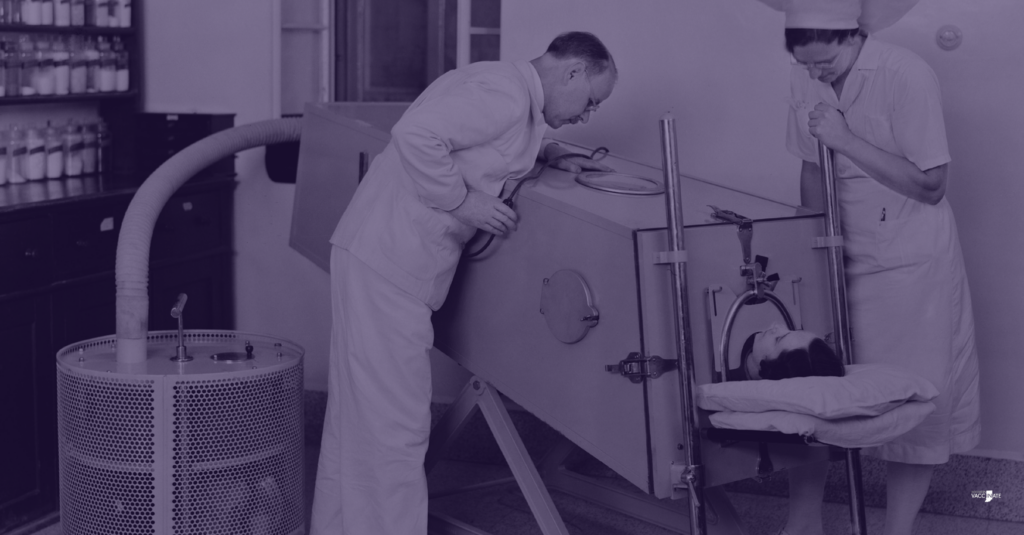
There were other things on TV too. Iron lungs. Some kids had to live inside one, and it breathed for them. It was like a big metal tube with just the kids’ heads sticking out. You could see their faces. Jeannie Tyler’s face.
When I got home from school that day, Mom made me sit at the kitchen table to have a snack. We were eating dinner late that night because Dad was going to the dentist after work. She gave me a piece of cinnamon toast with apple butter on it and a glass of milk.
“Sister said Jeannie Tyler has polio,” I told Mom.
She was pouring the milk from the bottle into my glass. Some of the milk spilled on the table. Mom got the dishrag from the sink and wiped up the milk. She went to the phone and called her friend from across the street, Mrs. Borkowski. I called her Mrs. B. Mom called her Agnes.
Mrs. B came over and sat on the front porch for a long while talking with Mom. I stood behind the screen door to listen but couldn’t hear anything. I knew they were talking about Jeannie Tyler.
After a few days, Sister Mary Magdalene moved Jeannie’s empty desk to the back of the row and told Walter Vukmanic to move his desk up to where Jeannie’s had been. Every day when I came into class, I would see the empty desk at the back of the room. Everybody could see it. When we came back to school after the Christmas and New Year vacation, Jeannie Tyler’s desk was gone.
On Easter Sunday night, the opera singer in the wheelchair was on The Ed Sullivan Show again. This time she was covered up by a sparkly white thing that hid the wheelchair pretty well, but I knew it was there. She sang “Bless This House.”
Monday after Easter was a school holiday. On Tuesday, after prayers and the Pledge of Allegiance, Sister Daria, the school principal, came into our classroom with Nurse Zimmerman and Marianne Cordon’s mother. They stood at the front of the room. Sister Daria was tall and thin and stood up very straight. She wore those awful nun eyeglasses all the sisters wore, but she wasn’t mean.
“How many of you watched The Ed Sullivan Show last night?” she asked the class.
All the hands went up. Everyone watched The Ed Sullivan Show.
“So you saw the tape from some years ago of Miss Lawrence singing ‘Bless This House.’”
Everyone nodded.
“This brave lady was struck with polio when she was still a beautiful young woman and a very famous singer all over the world. You all know about your classmate Jeannie. Now there is a way to keep this from happening, and Nurse Zimmerman and Mrs. Cordon and I are here to tell you about it.”
Nobody moved.
“Right here in our city, a great man named Dr. Jonas Salk at the University of Pittsburgh has found a way to protect us all from polio. It’s called a vaccine, and it keeps you from catching polio. He is making it available to the whole world. Because we are here in Pittsburgh, we will be the first to get it.”
Nurse Zimmerman, all starchy white with a white nurse’s hat, told us that in two weeks one of our parents was to come to school with us in the evening, and we would each be given a shot that would protect us from polio for our whole lives.
I knew about shots. We all knew. They hurt. We had to get a shot before we started kindergarten. It hurt a lot. I cried. And I got sick for two days and then got a scab on the arm where they gave me the shot. Then the scab fell off and you could see the scar. I touched the scar on my left arm. It didn’t hurt anymore, but you could still see it.
“This shot will not hurt,” Nurse Zimmerman said. Even her shoes and stockings were white. “And there will be no scar, as with the smallpox vaccine. Just one little pinch and it will be over. I know you’ll all be very brave.”
Marianne Cordon’s mother handed out letters and told us we had to give them to our parents so they would know about the vaccine and when to bring us to school. I took the letter home and gave it to Mom. Mom called Mrs. B., whose daughter Barbara, a year older than me, had brought her a letter too.
One night we went to the school auditorium and stood in line. Mom rolled up my left sleeve. Nurse Zimmerman wiped my arm with a ball of cotton wet with something that smelled strong and stuck the needle in my arm. Nurse Zimmerman was right. The shot didn’t hurt. The needle was big and scary-looking, but it didn’t hurt. Nobody cried.
A lady I didn’t know put a Band-Aid over where I got the shot, and Marianne Cordon’s mother handed me a lollipop wrapped in paper that said “No More Polio.” We went home, and there was no school the next day so we could rest. Mom wouldn’t let me go out to play. I had to stay home and be quiet.
That summer I went swimming a lot. Mom, Mrs. B., Mrs. McGrath, and Mrs. Pecora took turns taking a bunch of us kids to the pool in Highland Park. Some weeks we went almost every day.
Then summer was over and we had to go back to school. Fourth grade class was all the same kids except for Matthew Weimer, whose dad got a new job and they had moved away to California. Our new teacher was Sister Marie Elise. She wore the nun glasses, but she smiled a lot and even laughed.
Fourth grade. We would be learning fractions in arithmetic and a new subject, geography. First we had to do the stupid thing about how we spent our summer. I told about going swimming at Highland Park. Vicky Gulia came after me. She cried a lot because her precious Andrea Doria got hit by another boat and sank in the ocean. She cried so much she couldn’t talk, so Sister told us all to line up — boys on one side of the room and girls on the other. We were going to have a spelling bee. If you missed a word, you had to sit down. It was just me and that ugly Millicent McClure left, but I misspelled Massachusetts and Millicent won.
Sister told us that after recess there would be an assembly in the auditorium. I sat next to Clara Morris, who was nice and I liked her. Sister Mary Magdalene came into the auditorium leading her new third-grade class. I saw Clara’s eyes get real big and she pointed.
“Look,” she whispered.
Jeannie Tyler.
She was here. She was limping into the auditorium. She had a big, shiny steel brace on her right leg. She had a crutch. No wheelchair. She walked by herself, very slowly, all the way up the aisle to where the third grade was supposed to be and sat down.
“It’s Jeannie,” I whispered to Clara.
Sister Marie Elise came over and stood next to me, her finger over her lips to say quiet, no talking.
Sister Daria stood up and said that before the assembly began we were to welcome back our classmate Jeannie Tyler. Everybody clapped their hands. Jeannie turned around and waved to everybody with her left arm and gave her sad little smile.
There were a lot of things everybody wanted to ask Jeannie. Like about the iron lung. Did she have to go into one? How did she eat? How did she go to the bathroom? Did she have a wheelchair at home? Did the brace hurt her leg?
Jeannie was not the kind of girl you asked questions to, no matter how much you wanted to know. And I wanted to know.
“I’ll find out everything,” I told Clara Morris after the assembly.
I did too. I had my sources. Mrs. B. got her hair done at the beauty parlor owned by Jeannie Tyler’s mother. By careful listening, I learned that Jeannie’s case was not too serious. She was never in an iron lung. She used a wheelchair at the beginning, but she learned to walk again. At home, she did not use the crutch except when she was tired. Someday the brace would come off, or that’s what Mrs. Tyler hoped.
I hoped so too. We all did.
John Gardner was born in Pittsburgh. This piece is drawn from his childhood memories of growing up there before the polio vaccine changed daily life. After working as a university librarian, he spent forty years in scientific, medical, and technical publishing, serving in roles ranging from marketing to commissioning editor to Editor-in-Chief. In 1992, he was transferred to Paris, where he developed international publishing programs across Europe and Asia. After twenty years in France, he retired from publishing and now lives in Spain.